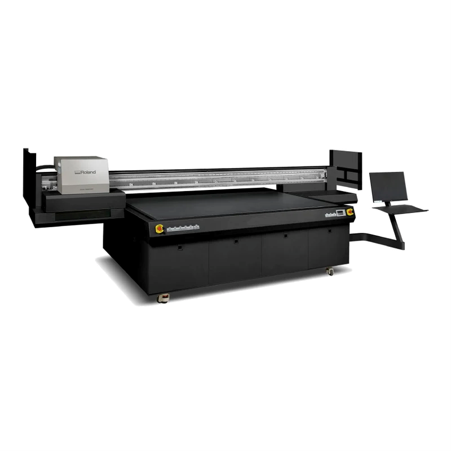
If you’re currently running eco solvent machines or considering adding new capabilities to your workflow, the Roland EU-1000MF platform, often referred to as the Roland EU21000 series, is worth a closer look. Initially launched in Europe in 2023, it opens up a different type of printing altogether, both in terms of materials and applications.

So, what exactly is the Roland EU21000? How can it help you expand into UV flatbed production, and what can it do for your business?
What Is The Roland EU21000?
The Roland EU21000 is a UV flatbed printer designed for direct-to-substrate printing.
Unlike traditional roll-to-roll printers, which print onto flexible media like vinyl or banner material, a flatbed UV printer allows you to print directly onto rigid surfaces. This includes materials such as acrylic, wood, glass, metal, foamex and PVC to mention but a few and basically, if you can think of it, you can probably print on it.
The Roland EU-1000MF sits within Roland’s VersaOBJECT range, which is focused on object and product printing rather than standard signage workflows. This makes it a very different proposition compared to eco-solvent printers, opening up new production possibilities rather than replacing existing ones.
How UV Printing Technology Works
To understand what the Roland EU21000 can do, it helps to understand how UV printing differs from eco-solvent printing. Eco-solvent printers use inks that penetrate the surface of the media and then dry over time through evaporation. This works well for flexible materials but limits the range of substrates you can use, and can take longer for the finished product to cure.
The Roland EU-1000MF uses UV-curable inks that are instantly hardened using UV light as soon as they are printed. It differs in that the ink sits on the surface rather than soaking in and prints are immediately dry and ready to handle. It also means you can print onto non-porous materials like glass too. This near-instant curing process is what allows UV printers to work across such a wide range of substrates.
Key Capabilities Of The Roland EU-1000MF
The Roland EU21000 isn’t just about printing on different materials. It also offers capabilities that can add value to your output. One of the key features is the ability to print with white ink and varnish layers.
White ink allows you to:
- Print onto transparent or dark materials
- Create solid base layers for colour printing
- Improve colour vibrancy on challenging substrates
Varnish adds another dimension entirely. It can be used to:
- Create gloss or matte finishes
- Add texture and raised effects
- Highlight specific areas of a design
Print Quality And Detail
The Roland EU-1000MF is designed to deliver high-resolution output across a range of materials. Because the ink sits on the surface, rather than being absorbed, you can achieve crisp detail, strong colour density and sharp edges on text and graphics without the bleed sometimes associated with eco-solvent printers.
This is particularly important for applications such as point-of-sale displays or packaging prototypes where high definition and a clean product are essential. It’s particularly helpful for businesses looking to offer more premium or specialist products, where this level of quality can be a key differentiator.
Production Workflow And Efficiency
One of the practical advantages of the Roland EU21000 is how it fits into production workflows. Because UV ink cures instantly, there is no waiting time between printing and handling.
This can improve turnaround times, particularly for short-run or custom jobs. Flatbed printing also removes the need for mounting in many cases, as you’re printing directly onto the final substrate.
What Applications Is It Best Suited For?
The Roland EU-1000MF is suited to a wide range of applications, particularly where flexibility and customisation are important. Common uses include rigid signage, personalised products such as mugs and pens, promotional items, packaging prototypes, particularly on things like tins, or industrial or specialist printing.
If you’re looking to diversify beyond standard signage, this type of machine can open up new revenue streams and allow you to reach other target markets.
Who Should Be Considering The EU21000?
The Roland EU21000 is not necessarily a replacement for existing print setups. Instead, it’s an addition that expands what your business can offer.
It’s particularly relevant for:
- Print businesses looking to move into UV printing
- Sign makers wanting to produce rigid signage in-house
- Companies offering custom or personalised products
- Businesses exploring higher-margin specialist work
A Practical Way To Expand Your Capabilities
The Roland EU21000 represents an opportunity to expand your production capabilities rather than simply upgrading your existing setup. By adding UV flatbed printing, you can take on new types of work, offer more customised products and move into areas that may currently be outsourced.
Want to explore what UV printing could do for your business? Contact us today and speak to the Signmaster team about the Roland EU21000.