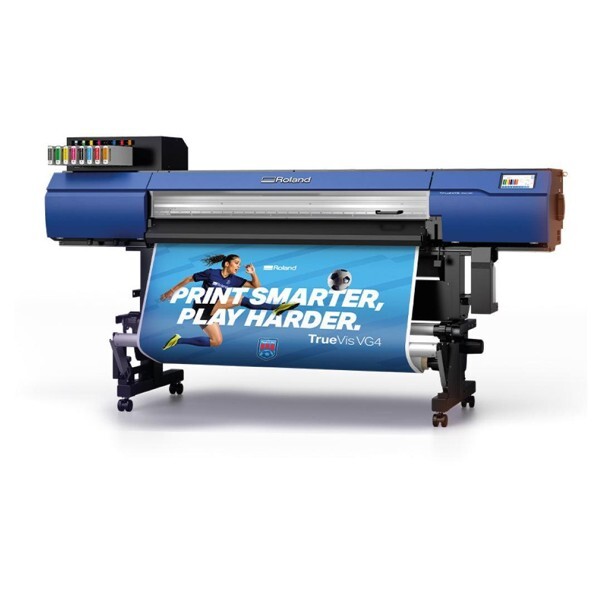
If you’re currently running a Roland VG3 printer, or you’re evaluating the TrueVIS range for your next investment, the launch of the Roland VG4 naturally raises the question: what’s actually changed, and does it make commercial sense to upgrade?

On the surface, the Roland VG4 vs VG3 comparison looks like a typical generational update. But when you look more closely at printheads, ink performance and production efficiency, there are some important differences that can have a real impact on day-to-day output.
An Evolution Of The TrueVIS Platform
The Roland TrueVIS VG3 established itself as a reliable print and cut platform, combining strong colour output with a straightforward workflow. It’s been widely used across sign making, vehicle graphics and general wide format production. Rather than replace that platform entirely, the Roland VG4 builds upon it.
The fundamental concept remains the same in that it’s a fully integrated print and cut system, but the VG4 introduces refinements aimed at improving consistency, throughput and usability in a production environment. For existing users of the Roland DG VG3, this means you’re not learning a completely new system, but you are gaining improvements where they matter most.
Printhead Technology And Output Quality
One of the more important technical areas to look at in the Roland VG4 vs VG3 comparison is printhead performance. While VG3 printers already deliver high-quality output, the VG4 is designed to improve precision and consistency across longer runs. This is particularly relevant for businesses producing repeat jobs or colour-critical work.
Improvements in droplet control and ink placement will help you to produce sharper fine details, smoother gradients and more consistent solid colours. In real-world terms, this means fewer variations between prints and greater confidence when re-running jobs, which can all help boost your bottom line.
Ink Performance And Colour Capability
Both the Roland TrueVIS VG3 and VG4 use eco-solvent ink technology, but the newer platform is designed to make better use of ink performance. The VG4 benefits from refinements in ink delivery and curing behaviour, helping to achieve:
- Improved colour vibrancy
- Better ink adhesion across a wider range of media
- More stable drying performance
For your print business, it means you run into fewer issues with smudging, more reliable handling and better overall finish quality.
Production Speed And Throughout
Speed is always a headline factor and naturally important in a high-pace print shop environment where you need to turn orders around fast. But in practice, production efficiency matters more than raw numbers. When comparing the VG3 640 to the Roland VG4, the focus shifts towards usable speed rather than maximum speed.
The VG4 is designed to optimise:
- Pass count efficiency
- Print mode performance
- Job processing times
This means you can maintain quality while increasing throughput, rather than having to choose between speed and output. And when your print shop is operating at near full capacity, or you’ve back-to-back jobs on the go, even incremental improvements in throughput can have a noticeable impact over time.
Integrated Print And Cut Workflow
Both machines operate as integrated print and cut systems, which remains a major advantage. The alignment between printing and contour cutting is essential, especially for items like stickers, labels, decals and short-run graphics.
The VG4 continues to refine this process, with improved accuracy and reliability in cut alignment. This reduces the need for manual adjustments and minimises waste caused by misalignment, which can be a hidden cost in production.
Media Handling And Versatility
Media flexibility is another important consideration when looking at the Roland VG4 vs VG3 and both machines support a wide range of materials, including:
- Vinyl
- Banner media
- Heat transfer materials
- Wrap films
The VG4 is designed to improve handling across these substrates, particularly in terms of stability and consistency during longer runs. For businesses working across multiple applications, this versatility is essential. It allows you to take on a broader range of work without needing additional machines.
Ease Of Use And Workflow Integration
One of the reasons the TrueVIS range is so widely adopted is its ease of use, which makes it accessible to even inexperienced operators and reduces training time when onboarding new staff. The VG4 also maintains a familiar interface and workflow, making it readily accessible for workers who are already comfortable with Roland systems.
From a practical perspective, it results in less risk of operational disruption during installation and enables you to get up and running faster.
Is It Worth Upgrading From A VG3?
The decision to upgrade from a Roland VG3 printer depends largely on your production needs.
If your current VG3 is reliable, comfortably meeting your output demands and producing consistent quality that your clients are happy with, then an immediate upgrade may not be needed.
However, if you’re increasing production volume, expanding into more demanding operations and/or looking to improve efficiency, then the Roland VG4 offers clear advantages in consistency, workflow and throughput.
A Practical Step Forward, Not A Radical Change
The Roland VG4 doesn’t reinvent the print and cut category, but it doesn’t need to. Instead, it refines a proven platform, focusing on the areas that directly affect productivity and reliability. For print businesses, that’s often exactly what you want - steady, practical improvements that support growth without adding complexity.
Thinking about upgrading from a VG3? Request a call back and speak to the Signmaster team about whether the VG4 is the right next step for your business.