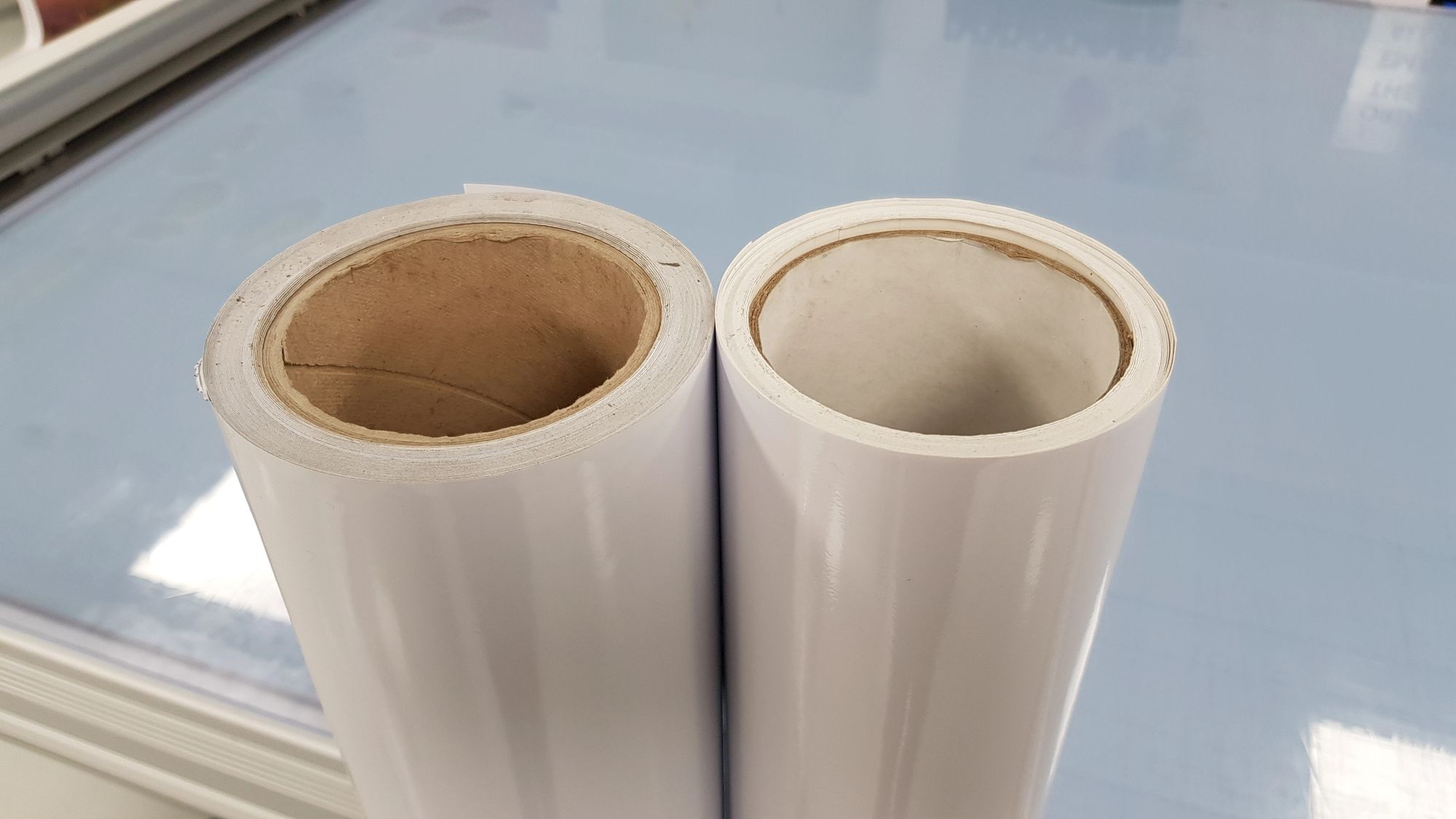
If you are specifying vinyl for a signage job, one of the first decisions you will face is whether to use monomeric or polymeric. Understanding the difference between monomeric and polymeric vinyl is fundamental to recommending the right product to your client and avoiding costly reprints or early failures. The choice is not simply about price; it is about matching the material to the application, the environment, and the expected lifespan.

What Is Vinyl Made Of?
Before exploring the differences, it helps to understand what vinyl actually is. Most self-adhesive vinyl used in the sign and print industry is made from polyvinyl chloride (PVC). On its own, PVC is rigid and brittle, so manufacturers add plasticisers to make it flexible and workable. Plasticisers are chemical additives that soften the PVC film and give it the flexibility needed for application and long-term performance.
The type and length of the plasticiser molecule used in the manufacturing process is exactly what distinguishes monomeric from polymeric vinyl.
What Is Monomeric Vinyl?
In monomeric vinyl, the plasticiser is short chain, meaning it consists of individual, relatively small molecules. Short chain plasticisers do not bond as securely to the PVC film, which means they are more prone to migration over time. Migration occurs when the plasticiser gradually moves out of the film, causing the vinyl to become stiffer, more brittle, and more prone to shrinkage. As the plasticiser migrates it can also cause problems with ink adhesion and colour fidelity.
Because of this, monomeric vinyl is better suited to flat, smooth, indoor surfaces where the risk of exposure to UV, moisture, and temperature fluctuation is low. Its typical lifespan is two to five years under normal indoor conditions. The trade-off for lower durability is cost: monomeric vinyl is noticeably cheaper than polymeric, making it a practical choice for short-term indoor applications, promotional signage, and budget-conscious jobs where longevity is not the priority.
Typical applications include:
- Indoor retail signage
- Short-term promotional displays
- Flat wall or window graphics (interior use)
- Point-of-sale applications
- General flat-surface indoor graphics
What Is Polymeric Vinyl?
Polymeric vinyl uses a long chain plasticiser, which means the molecules are larger and bond more securely to the PVC film. Because they bond more effectively, they are significantly less prone to migration, which keeps the film more stable, flexible, and dimensionally consistent over time. This translates into less shrinkage, better resistance to outdoor conditions, and a longer working lifespan of five to seven years.
Polymeric vinyl is more versatile in terms of the surfaces it can be applied to. It is stable enough to handle mild curves and compound bends, making it suitable for applications where monomeric would fail. It is also more resistant to UV degradation, moisture, and temperature extremes, all of which makes it the preferred choice for outdoor signage.
Polymeric vinyl costs more than monomeric, but the extended lifespan and broader range of applications typically justify the additional investment, particularly when clients expect their graphics to perform reliably outdoors for several years.
Typical applications include:
- Outdoor signage and fascia graphics
- Vehicle graphics on flat or mildly curved panels
- Shop front and window graphics (exterior)
- Long-term wall and hoarding graphics
- Bus shelters and outdoor display applications
What About Cast Vinyl?
It is worth noting that a third category exists beyond the monomeric versus polymeric distinction: cast vinyl, sometimes called wrap or cast film. Cast vinyl is manufactured using a different process entirely, which produces a thinner, more conformable film that can be applied to complex curves, deep recesses, and heavily textured surfaces.
Cast vinyl is the preferred material for full vehicle wraps, fleet graphics, and any application requiring the vinyl to conform to very complex shapes over extended distances. It is the most expensive of the three categories, but for demanding applications it is the only material that performs reliably over time.
Understanding Plasticiser Migration In Practice
Plasticiser migration is the underlying mechanism that determines how well a vinyl performs over its lifespan. The longer the plasticiser chain, the more securely it remains in the film and the more stable the vinyl stays. In practice, this means:
- Monomeric vinyl shrinks more readily, particularly around edges and corners, which can cause lifting or peeling.
- Polymeric vinyl retains its dimensions more reliably, producing a cleaner, more durable finish over time.
- For digital print applications, migration can affect how well the ink bonds to the surface. A more stable vinyl provides a more consistent substrate for ink adhesion.
This is why matching the vinyl to the application matters. Using monomeric vinyl outdoors, or on a vehicle, is a common and avoidable mistake that leads to premature failure.
Quick Comparison Summary
|
Monomeric Vinyl |
Polymeric Vinyl |
|
|
Plasticiser chain |
Short |
Long |
|
Migration risk |
Higher |
Lower |
|
Shrinkage |
More prone |
More stable |
|
Lifespan |
2 to 5 years |
5 to 7 years |
|
Surface types |
Flat, smooth |
Flat and mild curves |
|
Indoor/outdoor |
Indoor |
Indoor and outdoor |
|
Relative cost |
Lower |
Higher |
Which Vinyl Should You Choose?
Understanding the difference between monomeric and polymeric vinyl makes the decision straightforward once you know the answers to three questions:
- Where is it going? Indoors on a flat surface, monomeric is likely adequate. Outdoors, or anywhere with UV or moisture exposure, use polymeric as a minimum.
- How long does it need to last? For short-term or campaign-based graphics, monomeric is cost-effective. For signage expected to last several years, the additional cost of polymeric is justified.
- What surface is it going on? Flat surfaces are fine for either material. Mild curves require polymeric. Complex curves, recesses, and full vehicle wraps require cast vinyl.
Asking your clients these three questions before specifying a material will prevent the majority of premature failures and callbacks.
Shop Vinyl At Signmaster
Whether you need monomeric vinyl for a flat indoor application, polymeric vinyl for an outdoor sign, or cast vinyl for a vehicle wrap, Signmaster stocks a comprehensive range of digital print media to suit every application and budget. If you are unsure which material is the right fit for a specific job, the team at Signmaster is happy to advise. Get in touch with our team to discuss the difference between monomeric and polymeric vinyl and find the right product for your next project.