How The Mimaki CJV200 Evolved From The CJV150: Key Improvements For Modern Print Businesses
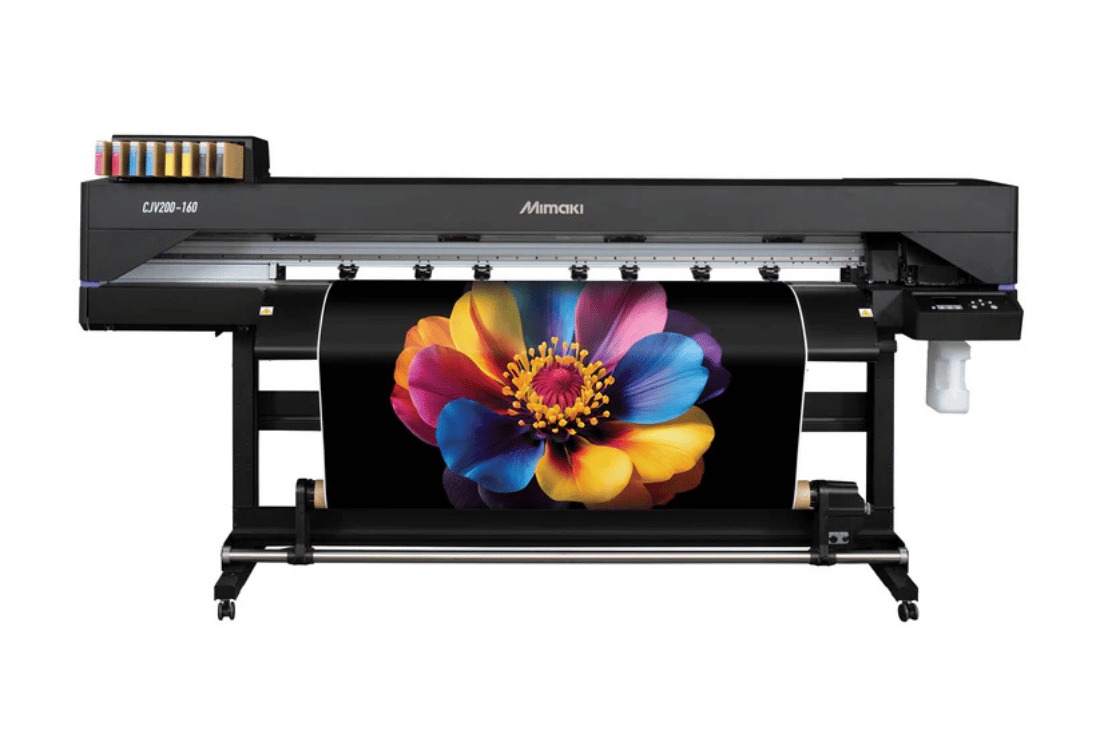
For many years now, the Mimaki CJV150 has been a trusted workhorse for print businesses up and down the country. When it first hit the market it earned a strong reputation for reliability, solid print quality and dependable print-and-cut performance. It helped sign shops, graphics companies and small commercial printers deliver everything from decals and posters to banners and vehicle graphics.
But print demands have changed. Faster turnaround, higher colour expectations, tighter deadlines and more diverse applications are now the norm. That’s where the Mimaki CJV200 steps in, not as a radical departure, but as a carefully evolved successor designed for today’s production environment.
A Natural Evolution, Not A Reinvention
The success of the CJV150 gave Mimaki a strong foundation to work from. It already offered what many print businesses needed: reliable roll-to-roll printing, integrated cutting, stable performance and consistent quality.
Rather than reinventing the platform, Mimaki focused on refinement with the Mimaki CJV200 improving performance in key areas including speed, efficiency, usability and consistency. The result is a machine that feels familiar to experienced Mimaki users, but significantly more capable in daily production.
Improved Print Engine And Output Efficiency
One of the most noticeable upgrades when moving from the Mimaki CJV150 to the Mimaki CJV200 is the performance of the print engine. The CJV200 benefits from newer printhead technology designed to increase productivity without sacrificing quality.
For busy print shops this translates into faster practical print speeds, smoother gradients and solid colour areas, more stable output across longer runs and better performance at higher production settings.
As a wide format printer, the CJV200 remains focused on versatile roll media, but with improved handling and output consistency that suits higher-volume production environments better than the older platform.
Greater Ease Of Use For Modern Operators
One of the common pain points with older generation machines is the level of manual intervention required. The Mimaki CJV150 was well regarded for reliability, but modern print environments increasingly demand automation.
The Mimaki CJV200 improves the operator experience with an updated user interface design which allows for faster job setup, easier maintenance access and quicker daily cleaning routines.
These change the time you need to train operators and help maintain consistent output across shifts. This is a major benefit for growing businesses with multiple staff members and leads to fewer errors and smoother workflows.
Enhanced Print-And-Cut Accuracy
Integrated cutting is a core reason why both the CJV150 and CJV200 remain popular. However, one of the standout improvements in the new generation is cutting accuracy and reliability.
The Mimaki CJV200 benefits from refined registration systems that improve contour cutting precision, even on longer runs. This reduces misalignment on stickers, decals and shaped graphics which is one of the most common frustrations in older integrated systems after extended print runs.
As a print-and-cut machine, this improved accuracy makes the CJV200 better suited to today’s demanding output standards, particularly for short-run packaging, branding graphics and high-detail sticker production.
Media Handling And Stability Improvements
Modern media is more varied than ever. From ultra-thin films and wallpapers to heavier banner stock and specialist vinyl, today’s wide format printer needs to handle a broad range of materials without constant adjustment.
The Mimaki CJV200 benefits from improved media feed mechanisms, better tension control and more stable tracking over long distances. Compared to the Mimaki CJV150, this reduces:
● Media skew
● Tracking drift on long jobs
● Edge curl issues
● Operator intervention during runs
Workflow Efficiency For Modern Production
Print production has become far more workflow driven. Lots of jobs are often short-run, customised, repeatable and time-sensitive, and sometimes all at once. The CJV200 reflects this shift.
Compared to the Mimaki CJV150, the newer platform integrates more smoothly into modern digital workflows. Faster RIP processing, improved job queuing and better pass optimisation all contribute to a smoother production experience.
In practical terms, this means fewer delays between jobs, quicker response to urgent orders, and better utilisation of machine time across the working day.
Better Positioned For Today’s Sustainability Expectations
While both platforms support eco-solvent printing, modern print businesses also face increased pressure around waste reduction and environmental impact. The Mimaki CJV200 is more efficient in ink usage at production speeds, reducing overspray and ink wastage compared to older generation systems.
A Clear Step Forward In The Mimaki Printer Comparison
When viewed purely through a technical lens, the evolution from the Mimaki CJV150 to the Mimaki CJV200 is best described as refinement rather than revolution. But in production environments, those refinements add up quickly.
The CJV200 offers printers faster real-world output, better long-run stability and improved cutting accuracy. It also allows for easier day-to-day operation and smoother workflow integrations. For growing print businesses, these gains directly translate to higher throughput, lower waste and more predictable production.
Which Type Of Print Business Benefits Most?
Print companies upgrading from a Mimaki CJV150 to a Mimaki CJV200 typically fall into one of three categories:
First, businesses that have increased volume and need to push more work through the same floor space without adding additional machines.
Second, printers are moving into more brand-sensitive work where colour consistency, long-run stability and finish accuracy have become more demanding.
Third, growing operations that now rely on multiple operators and need simpler, more user-friendly control systems to maintain consistency across shifts.
For all three, the CJV200 offers a smoother, faster and more reliable production experience while preserving the familiar Mimaki workflow that many teams already know.
A Platform Designed For The Next Phase Of Growth
The Mimaki CJV150 played a major role in shaping modern integrated printing for many shops. But as expectations have grown, the Mimaki CJV200 has stepped forward as a machine better suited to today’s pace of production.
For print companies planning their next phase of growth, the shift from the CJV150 to the CJV200 represents a logical, practical and future-focused upgrade path.
Discover the Mimaki range with Signmaster. Contact us today.